Google adds TPU systems for confidential AI and long-context workloads
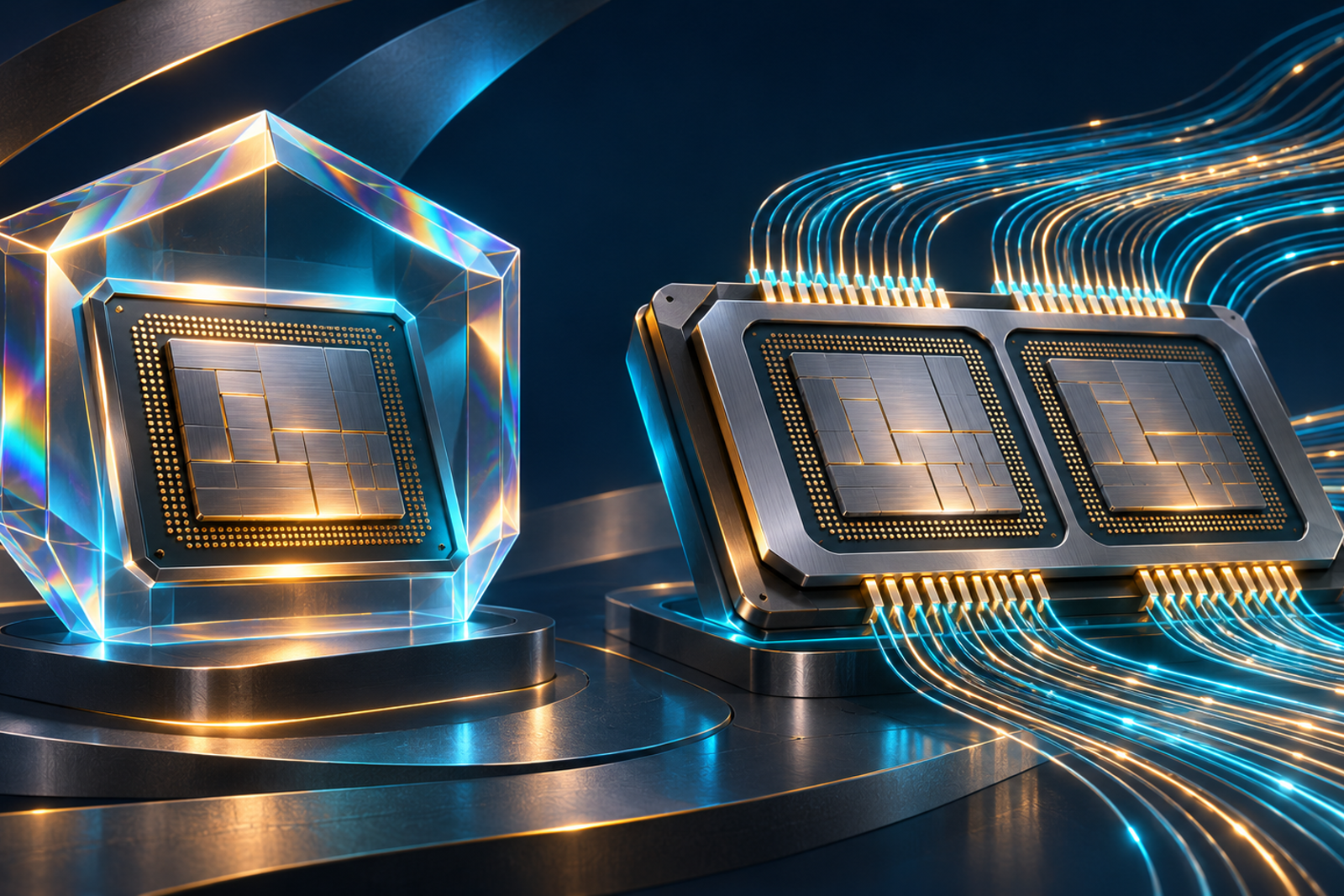
Google is adapting existing silicon around two different deployment problems: protecting data in use and keeping large workloads fed with memory.
By guthlabs.newsroom
November 10, 2026
Announcement: November 9, 2026
Google introduced TPU 8tx and TPU 8i Max on November 9, extending its eighth-generation accelerator portfolio with systems aimed at confidential computing and memory-intensive AI. The announcement concerns new configurations of existing silicon, an important distinction from a completely new chip generation. Google’s announcement.
TPU 8tx combines TPU 8t silicon with fifth-generation AMD EPYC host processors and hardware protections for data and model weights during processing. Google says its Boardfly interconnect can deliver up to a twofold latency improvement over TPU 8t, with little performance overhead for the security features. Those comparisons are the vendor’s claims. Google’s technical description.
TPU 8i Max puts two TPU 8i chips in one package. Google says the configuration doubles compute, SRAM and high-bandwidth-memory bandwidth relative to TPU 8i. The announcement does not provide customer pricing or a dated, region-by-region general-availability schedule. Google’s system details.
The business setting is increasingly consequential. Reuters reported that Alphabet described TPU sales as a meaningful contributor to its September-quarter results, when Google Cloud revenue reached $30.71 billion. The new configurations extend a product family that Google has been making available to outside customers as well as using internally. Reuters’ November 9 report.
The software determines how useful the hardware becomes
Google’s current documentation describes TorchTPU as a native PyTorch backend supporting familiar development and distributed-computing interfaces. Its serving options include vLLM and SGLang integrations, while Ray supports orchestration. This matters to teams evaluating a move because the cost of an accelerator includes the engineering needed to run and maintain the application, not simply the hourly hardware bill. Google Cloud’s PyTorch documentation.
The same documentation labels the TPU agent suite a preview and describes its initial focus as transformer inference on TPU v6e and TPU7x. It offers model onboarding, diagnostics, kernel development and documentation assistance. That narrower documented scope should not be read as proof that every automation already supports the newly announced eighth-generation systems. TPU agent suite documentation.
Two different buying decisions
For an enterprise handling confidential records, the useful evaluation is whether the protected-computing setup fits its threat model, key management and operational requirements. Hardware isolation does not, by itself, establish that an application’s tools, logs or human access are correctly controlled. A procurement review should test the complete path through which sensitive information moves.
For a long-context application, the practical question is how much useful work the system completes at an acceptable delay and cost. Doubling a hardware resource does not automatically double application throughput. Results depend on model architecture, request sizes, batching and the amount of coordination between devices.
The announcement therefore gives buyers two concrete architectures to investigate. Deployment decisions still require workload measurements, a confirmed commercial configuration and an availability commitment. The most informative next evidence will be production results that separate hardware improvements from software tuning and disclose the full cost of delivering the task.
Sources and citations
Revision history
Published .