Anthropic reports a Claude-assisted vault structure while the protein’s purpose remains unresolved
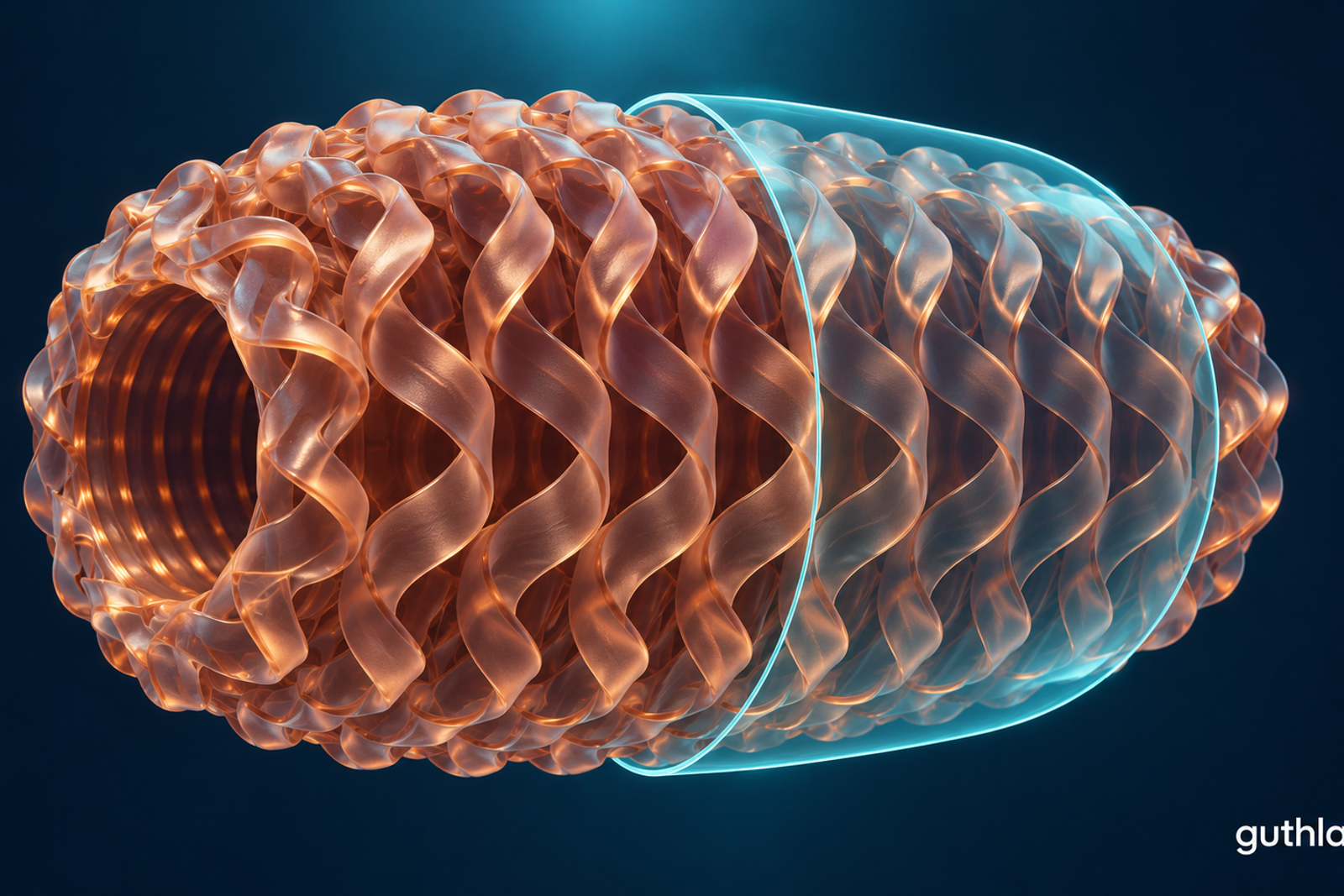
Anthropic’s biology research team reported a new vault-particle structure on November 4, describing a barrel-like assembly encoded by a bacteriophage and built from 96 copies of one protein. The team used cryo-electron microscopy and says Claude assisted several stages of the investigation under human direction. Anthropic research report
The result describes assembly, not biological function, which remains unknown. Anthropic shared it as an early preprint.
A longstanding biological question
Vaults have a much longer history than generative AI. Nancy Kedersha and Leonard Rome described the particles in a 1986 Journal of Cell Biology paper. Their electron-microscopy appearance suggested cathedral vaults, giving the structures their name. The original study identified them in preparations from several mammalian cell types. Original vault-particle paper
Related proteins were previously known. Anthropic now reports complete vault-like assemblies, although it has produced them only in E. coli and has not tested their formation in their natural hosts. Structural findings and limitations
A related structure gives researchers another object to compare. Similarity can motivate a hypothesis about shared origins or roles, but it does not by itself establish that two particles perform the same task. Structural description and biological explanation are separate achievements.
What the AI contribution establishes
Claude helped with database searches and microscopy analysis. The team reports a first structural model in 34 hours, compared with its estimate of weeks, but also describes errors that delayed work or produced a flawed intermediate map. These are observations from one team, not a controlled comparison. Research workflow and timing claims
The distinction is important when interpreting an AI-assisted discovery. A productive collaboration can involve researchers choosing the question, inspecting suggestions, performing experiments and deciding whether the evidence supports a conclusion. Crediting software for useful assistance does not require describing those human decisions as autonomous machine work.
Nor can a single successful case establish the typical return on a research assistant. To make that broader judgment, a laboratory would need to record unsuccessful suggestions, time spent checking outputs and the work required to reproduce a result. Otherwise, the visible success has no clear denominator.
Evidence beyond a compelling demonstration
For readers, the next questions are about scientific validation: whether the underlying data support the proposed structure, whether other researchers can reproduce it and what experiments can distinguish competing explanations of its role. An attractive molecular model does not answer all three.
Independent scrutiny can also separate errors of measurement from errors of interpretation. A plausible visual result is a starting point for that scrutiny, not a replacement for it. Readers should look for the data and uncertainty estimates behind the central claim.
For AI developers, the case is a reminder that useful research tools must preserve the connection between a claim and its evidence. Provenance, executable analysis and a record of human review can matter more than a polished narrative about discovery.
The reported vault is a concrete target for further study. Claude’s role is best understood as assistance within that investigation, with both the biological interpretation and the size of any general productivity benefit still open to examination.
Sources and citations
Revision history
Published .