MIPS advances Actus to bring AI and real-time control into robot joints
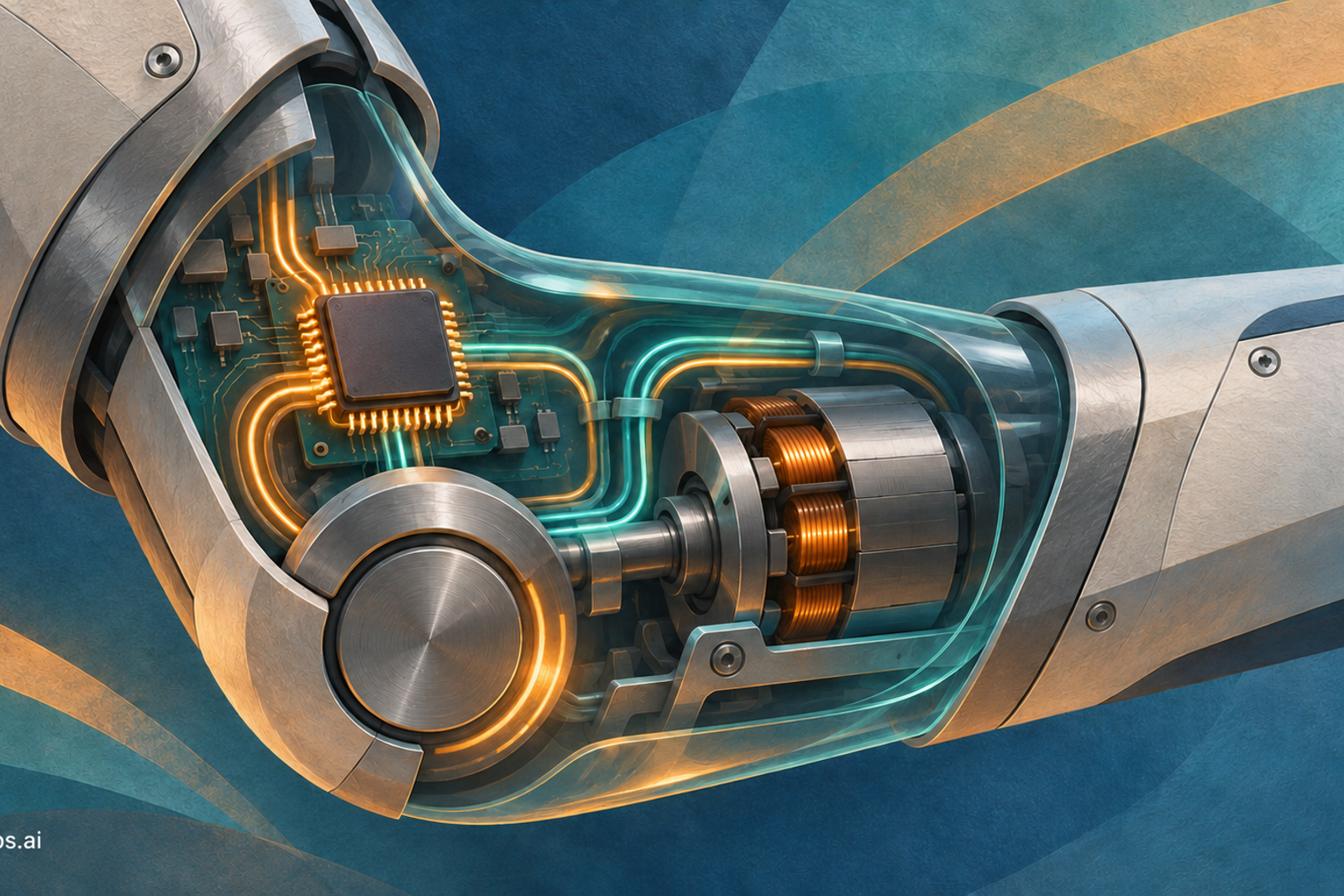
MIPS announced advances to its Actus reference platform on November 9, targeting the compact controllers inside robotic joints. The design combines motor control, local inference and communications on a chip using GlobalFoundries’ FDX technology, according to the company’s announcement.
The engineering focus is the connection between an AI system choosing a movement and the electronics executing it. For a small actuator, predictable timing must fit within limits on heat, power and space.
Control and networking share the platform
Actus brings together two MIPS Atlas M8500 real-time RISC-V processors and an ARC VPX 512-bit vector processor. MIPS describes hardware acceleration for motor-control calculations, high-resolution pulse-width modulation and local processing for functions such as sensor fusion and predictive maintenance. The platform also includes time-sensitive Ethernet networking and other interfaces for coordination between joints. Actus technical announcement
MIPS says development can begin on a virtual platform before moving to the Actus-1 evaluation board and SDK. That sequence makes early software work possible without establishing that production silicon is shipping in volume. Development path
Safety support still needs a system-level assessment
The Actus product page describes deterministic event handling, vector processing and software-first development through virtual platforms and digital twins. It also explicitly qualifies performance, security, safety and certification statements: results depend on final specifications, configuration, implementation, workload and the applicable certification scope.
That qualification matters when a component is intended for machines operating around people. A feature that supports a safety-oriented design does not, by itself, certify a complete robot or its intended use.
The benchmark is the joint under load
An evaluation should measure the complete control loop while communications and local inference are active. Developers will want to see whether a burst of sensor work changes response time, whether multiple joints stay coordinated and how the controller responds to a communication fault.
Thermal measurements and recovery behavior deserve the same attention as peak computation. Those are the tests that determine whether integrating more functions actually simplifies a compact actuator.
Actus puts MIPS’s physical-AI effort at the point where model output becomes movement. The next useful evidence will be production specifications and tests on representative motors and robot assemblies, with clear limits on what each safety and security claim covers.
Sources and citations
Revision history
Published .