Serve Robotics opens its fleet technology to other physical-AI companies
guthlabs.newsroom | Robotics Business | November 5, 2026
Serve Robotics launched Physical AI Services on November 5, making technology developed around its own robot operations available to other companies. The business starts with connectivity, data-curation tools and real-world training data. Bedrock Robotics, which develops autonomy for heavy construction equipment, is a named launch customer. Serve launch announcement
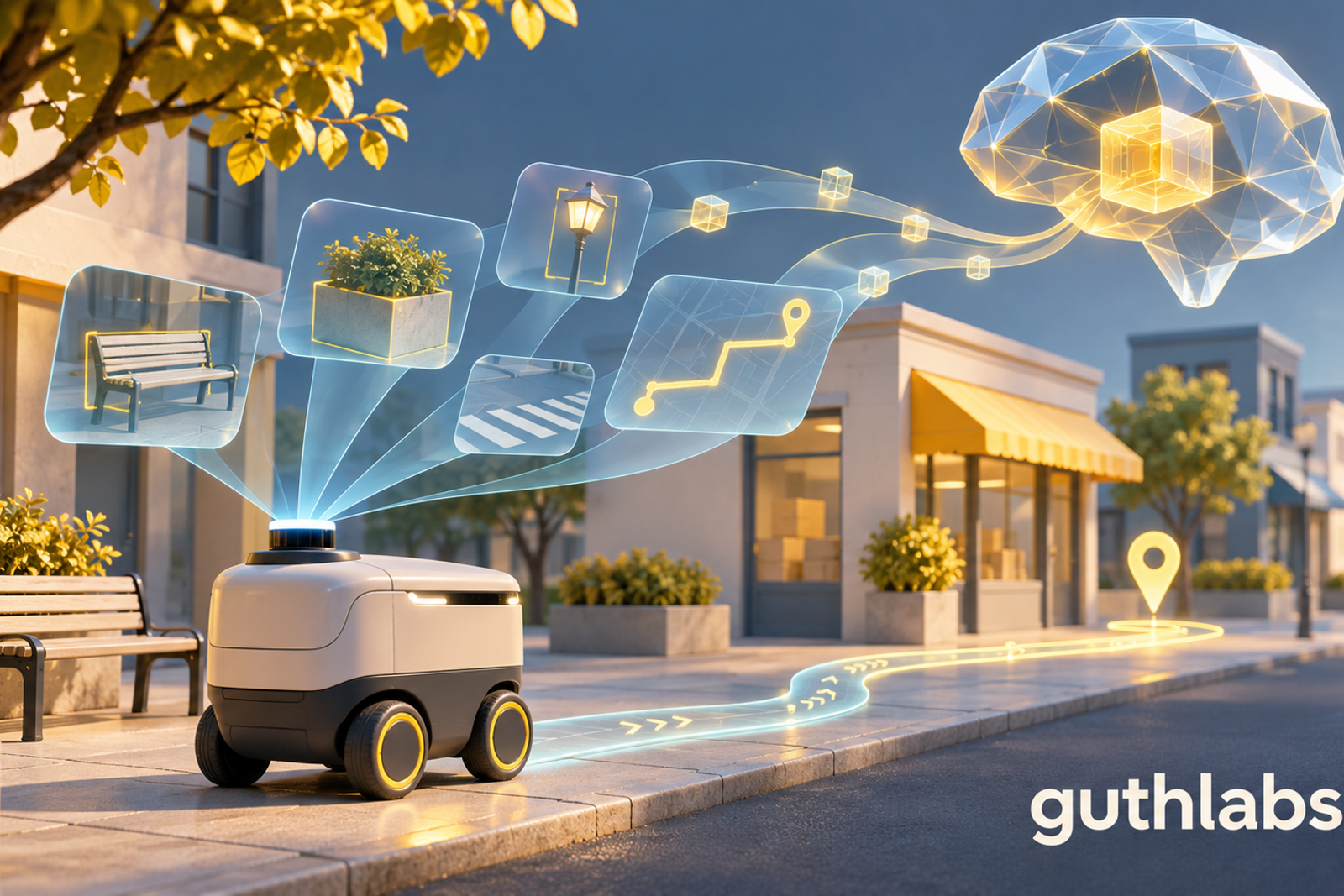
Serve Link connects field machines with off-board models and monitoring systems. Serve Data Curator is intended to identify useful examples within large volumes of fleet data. The data catalog draws on Serve’s sidewalk operations, including information about terrain and infrastructure. Serve says Bedrock uses Link across Wi-Fi, LTE, 5G and satellite networks. Serve launch announcement
The company says the services already support thousands of vehicles across a dozen industries. That is a company-reported deployment statement, not an independent reliability measurement. The release does not provide a public price list or a separate revenue figure for the newly named business. Serve launch announcement
Selling the systems behind the robot
The move gives Serve a commercial path beyond operating machines that carry its own brand. A tool built to support one fleet can become a product for others if it works across different hardware, environments and operating requirements. That opportunity depends on how much of the original system can be reused without expensive customization.
Serve’s same-day earnings release raised its full-year 2026 revenue guidance to $12 million from a previous $9 million to $10 million range. The company attributed the revision to robot demand and a broader mix of revenue streams. That company-wide outlook should not be read as a forecast for Physical AI Services alone. Serve third-quarter results
The business logic is that robot builders share some infrastructure problems even when their machines do different jobs. They need to move data, monitor operation and select examples that can improve their models. Buying those capabilities can be attractive if it reduces engineering effort without creating a new operational bottleneck.
Bedrock’s inclusion provides a concrete test of that proposition. Connecting heavy equipment at a worksite is different from supporting a sidewalk delivery robot. Successful transfer would demonstrate that at least some fleet technology can serve customers beyond the environment in which it was developed.
Data volume is only a starting point
For the curation and catalog products, value depends on relevance. Thousands of ordinary frames may add little to a training set, while a small number of unusual situations can expose a model’s weakness. Buyers need to understand how examples are selected, what context accompanies them and whether they match the conditions their own machines will encounter.
Connectivity has a similarly practical standard. Teams should examine how the system behaves during weak coverage, handoffs and outages, and which functions remain safe locally. A connection to remote intelligence cannot remove the need for a machine to handle a lost connection responsibly.
Serve’s launch turns internal fleet capabilities into an external product offering. The next business evidence will be repeat customers, integration effort and measurable operational gains. Those results will show whether technology proven within one company’s operations can become a dependable service for a wider robotics market.
Sources and citations
Revision history
Published .