N
Notebook + Files
Notes, to-dos, lists, drawings, projects, field guides, research, filing, lineage, recovery, and Agent records in one source-preserving system.
Active prototypeiPhoneApple family
Guth applications give people familiar places to write, plan, communicate, build, research, and experiment. The surfaces can specialize without splitting the underlying record, Agent identity, authority, or receipts into disconnected products.
The interfaces below are working product prototypes and design candidates. Platform and release status are labeled instead of implied.
Select a surface to inspect the current iPhone direction. Today compresses active work into a quiet starting point. Notebook and Files organize human and Agent records. Agenda, Messages, and Approvals expose time, collaboration, and decisions without turning a mobile interface into a control room.
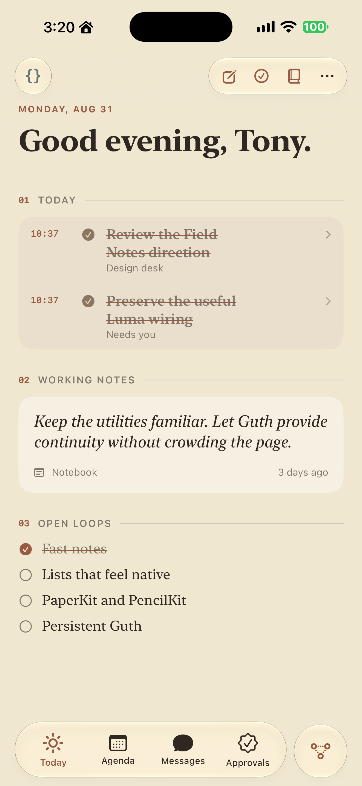
The family is organized around work people already recognize, not around a single endless AI chat. Some products are active prototypes, some are design candidates, and some remain held concepts. Shared contracts allow a record or Agent to move between them without pretending every capability is already shipped.
Notes, to-dos, lists, drawings, projects, field guides, research, filing, lineage, recovery, and Agent records in one source-preserving system.
Month, week, day, agenda, and deadline views backed by the same project and to-do records rather than duplicate scheduling data.
Experiments, instruments, worlds, research, qualification, failure evidence, and model comparison for bounded AI work.
Contacts, projects, approvals, work queues, communications, proposals, customer records, and accountable Agent jobs.
Source-backed content planning, drafts, asset selection, scheduling proposals, and publication approval without silent posting.
Media, writing, layout, captioning, timelines, and reusable assets with provenance and local-first editing routes.
Profiles, rooms, jobs, routes, skills, field guides, authority, communications, lineage, and receipts for persistent Agents.
Controlled local and cloud custody, partitions, backup, restore, portability, secure archives, and inspectable recovery.
Instruments, stacks, skills, plugins, MCP servers, APIs, schemas, App Intents, and capability documentation.
A project deadline can appear in a project, to-do list, agenda, Agent work queue, and approval surface. Those are projections of one controlled record, not five disconnected copies. The record retains its owner, source, status, authority, related files, receipts, and recovery history as the interface changes.
Interface state can remain local. Canonical changes require an authorized route and retain lineage.
Desktop Labs benefits from large graphs, instruments, and research workspaces. Notebook, Calendar, Messages, and Approvals benefit from fast native mobile interaction. The web provides discovery, documentation, public demos, account access, and broad compatibility. Shared schemas do not require identical interfaces.
Select a surface to see the context its Pointguard would activate. The same profile and authority boundaries remain in force while the current records, instruments, and available actions narrow to the work at hand.
Persistent engineering Agent. The profile remains versioned and source-bound while each app supplies a purpose-specific working context.
Public pages explain the system and allow bounded demonstrations without customer data. Signed-in applications connect private records, organization membership, Agent routes, and authorized storage. Account creation, provider connections, paid actions, and production effects remain separately gated.
Read assurance, security, identity, application, Labs, instrument, research, and glossary pages without granting the site access to private work.
Return to overviewExisting authorized accounts can enter the Guth workspace. The current local authentication gate remains real and does not manufacture a session during provider outages.
Sign in